TLMNI Funded Programmes: Nepal
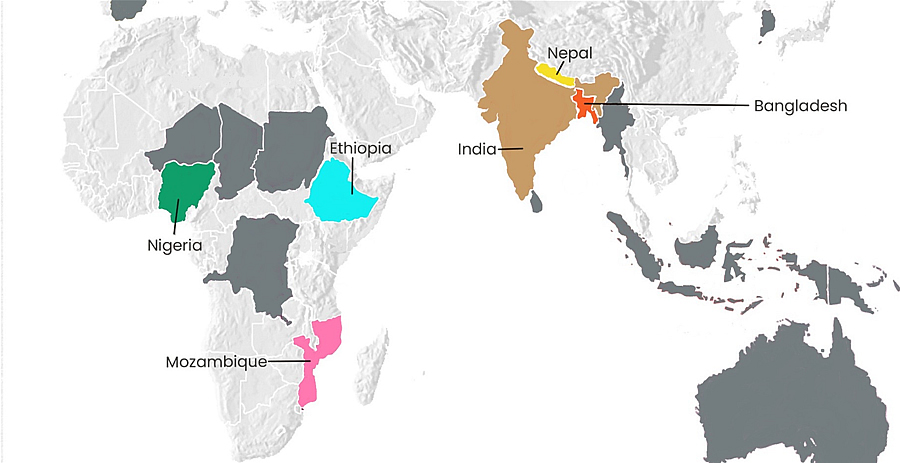
Click on the name of a country on the map or the list below to find out more.
Bangladesh | Ethiopia | India | Mozambique | Nepal | Nigeria
Nepal
Despite some success in reducing poverty levels in recent decades, Nepal remains one of Asia’s poorest countries. Recently, social unrest throughout the country has been fuelled by its widening income gap and rising levels of youth unemployment (22.7%). This unrest threatens political stability in Nepal.
Weather and geographical factors also affect development and economic growth prospects in Nepal. Lying on a fault line, Nepal is prone to earthquakes, and it is becoming more vulnerable to climate change, with floods and wildfires becoming more frequent.
Within this context, leprosy continues to spread at an exceptionally high rate in rural villages in Nepal. People affected by leprosy and disability in these forgotten areas are some of Nepal’s poorest and most marginalised. In 2024, a further 2,472 people were diagnosed with leprosy in Nepal.
TLMNI has a longstanding partnership with TLM Nepal. Thanks to your support, we contributed directly to activities in Nepal last year in the following areas:
Healthcare and Research at Anandaban Hospital
Nepal has one doctor for every 1,429 people, so your support here is vital. Anandaban Hospital, near Kathmandu, opened in 1957. It serves around 8,000 people affected by leprosy, plus general patients, every year. It provides wound care, reconstructive surgery, and treatment for leprosy reactions. The medical team run local clinics for outpatients. Counselling services are also available to patients and their families, as depression, anxiety and/or loneliness is not uncommon for persons affected by leprosy due to the stigma and discrimination attached to the disease.
Anandaban Hospital is also home to world-class leprosy research through the Mycobacterial Research Laboratory. Projects include developing a diagnostic test that will make identifying leprosy cases quicker and easier. Work will soon begin on constructing a brand new, state-of-the art research centre.
All of this would not be possible without your support.
Catastrophic landslides in September 2024 caused serious damage to the Anandaban Hospital site and initially affected service provision at the hospital. Your support contributed directly to on-site restoration efforts and ensured services quickly recommenced. Thank you for continuing to take action to help support people affected by leprosy in Nepal.
Case Finding, Health Education & Empowered Communities – Dignity First Project
In October 2025, Dignity First, a three-year project funded by Irish Aid, was concluded. Dignity First focused on improving health, wellbeing, and dignity for people affected by leprosy, disability and extreme poverty—especially women and girls—in four leprosy-endemic districts of Nepal.
Key achievements over the three years included:
- 38,305 people accessed health services including leprosy case detection (incl. skin camps, close contact tracing), treatment and hospital care
- 891 new leprosy cases were identified through community outreach
- 753 health workers were trained on leprosy signs, symptoms, screening practices and referral pathways – thus strengthening local healthcare systems and increasing access
- 226 patients received Reconstructive Surgery, while 4,520 sessions of occupational and physiotherapy were completed, helping patients to regain mobility and independence
- 596 members of Self-help groups received training on self-care, advocacy and income generation activities, thus empowering communities to improve their health and economic resilience.
We are grateful for the strong partnership that has been built up between Irish Aid and The Leprosy Mission Northern Ireland, and for the difference it is making to the lives of people affected by leprosy.
See our work in Mozambique for more information on how our partnership with Irish Aid is transforming lives.